Neurolexi is grounded in interdisciplinary aphasia research conducted in Switzerland.
E-Inclusion — Interdisciplinary Swiss Aphasia Research
Neurolexi is based on findings and methodologies developed within the interdisciplinary Swiss research project E-Inclusion. The project combined expertise from speech-language pathology, medical engineering, computer linguistics, and visual communication to explore new digital approaches for aphasia rehabilitation.
The research focused on three central topics:
digital aphasia therapy,
speech recognition and objective speech analysis,
and the role of Swiss German and High German in language rehabilitation.
The project involved collaboration with numerous rehabilitation clinics, hospitals, and speech therapy practices across Switzerland, including acute care hospitals, rehabilitation centers, and private therapy practices.
A total of 33 people with aphasia and 33 control participants without aphasia participated in the primary naming study investigating image types and language varieties.
In a second longitudinal study, 22 people with aphasia completed repeated speech recordings across two to four measurement sessions. More than 1,200 speech samples were collected to investigate objective acoustic markers such as naming latency and speech timing.
The project further included:
development of image-based therapy stimuli,
Swiss German and High German speech libraries,
automated speech recognition pipelines,
and prototype tablet-based therapy applications.
The findings of E-Inclusion form an important scientific foundation for Neurolexi’s ongoing development of digital speech therapy technologies.
Publications
E-Inclusion — An Interdisciplinary Swiss Aphasia Research Project (2021)
This publication presents the overall E-Inclusion research initiative, an interdisciplinary Swiss project focused on developing a prototype app for aphasia therapy. The project combined expertise from speech-language pathology, medical engineering, computer linguistics, and visual communication. Two main studies and five supplementary studies investigated picture naming, speech analysis, language varieties, and digital therapy technologies. A particular focus was placed on Swiss German and High German language processing, automated speech recognition, and objective acoustic speech measurements such as naming latency.
Source
Widmer Beierlein, S., Reymond, C., Kuntner, K. P., et al. (2021). E-Inclusion – Ein interdisziplinäres, schweizerisches Aphasie-Forschungsprojekt. Aphasie und verwandte Gebiete, 50(2), 68–80. DOI: 10.26041/fhnw-4213.
Automatic Detection of Naming Latency from Aphasia Patients Using an Extended Threshold-Based Method (2020)
This study investigated whether naming latency — the time between seeing an image and beginning speech — can be measured automatically in people with aphasia. Researchers developed an algorithm based on speech wave envelopes and compared automated measurements with manually annotated gold-standard data. Speech recordings from aphasia patients across four evaluation sessions were analyzed. The results demonstrated a very high correlation between automatic and manual measurements, supporting the feasibility of objective speech-based progress tracking in digital aphasia rehabilitation.
Source
Altermatt, S., Kuntner, K. P., Rickert, E., Wyss, S., Degen, M., Reymond, C., Widmer, S., Blechschmidt, A., & Hemm, S. (2020). Automatic detection of naming latency from aphasia patients – using an extended threshold-based method. Conference publication, 2020.
Patient-Friendly Speech Recognition Feedback for Aphasia Patients (2020)
This publication explored how speech recognition systems can be adapted specifically for people with aphasia. The research focused on improving usability and making automated speech feedback more understandable and clinically relevant for patients during therapy exercises. The work contributed to the development of patient-centered digital therapy interfaces and speech processing pipelines within the E-Inclusion framework. The study highlighted the importance of accessible feedback systems for independent home-based speech therapy.
Source
Wyss, S., Rickert, E., Altermatt, S., Kuntner, K. P., Degen, M., Reymond, C., Widmer Beierlein, S., Blechschmidt, A., & Hemm, S. (2020). Patient-friendly speech recognition feedback for aphasia patients. EMBEC Conference Proceedings, 2020. DOI: 10.26041/fhnw-4206.
Evaluation of the Potential of Automatic Naming Latency Detection for Different Initial Phonemes During Picture Naming Task (2021)
This study evaluated how different initial speech sounds influence automatic naming latency detection during picture naming tasks. Using speech samples from 123 healthy participants, the researchers compared manual and automated speech onset detection methods across various phoneme groups. The results showed strong correlations between manual and automatic measurements, while also demonstrating that phonetic characteristics such as fricatives or nasals can influence detection sensitivity. The publication further supports the clinical feasibility of integrating automated naming latency analysis into digital aphasia therapy applications.
Source
Park, S., Altermatt, S., Widmer, S., Blechschmidt, A., Reymond, C., Degen, M., Rickert, E., Wyss, S., Kuntner, K. P., & Hemm, S. (2021). Evaluation of the Potential of Automatic Naming Latency Detection for Different Initial Phonemes during Picture Naming Task. Proceedings of the 43rd Annual International Conference of the IEEE Engineering in Medicine & Biology Society (EMBC), 2021.
Automated Naming Latency Detection for Aphasia Speech Analysis (2025)
This research further advanced automated naming latency detection methods for aphasia speech analysis using signal-processing and phoneme-specific optimization techniques. The study combined amplitude- and slope-based detection algorithms with speech recognition approaches to improve robustness across different speech conditions and phoneme groups. Large datasets from healthy participants and people with aphasia were analyzed to validate the system. The work contributes to the development of objective, scalable, and data-driven speech rehabilitation technologies for future clinical and home-based therapy applications.
Source
Rickert, E., Hemm, S., Altermatt, S., et al. (2025). Automated naming latency detection for aphasia speech analysis. Biomedical Signal Processing and Control, 113, 108851.
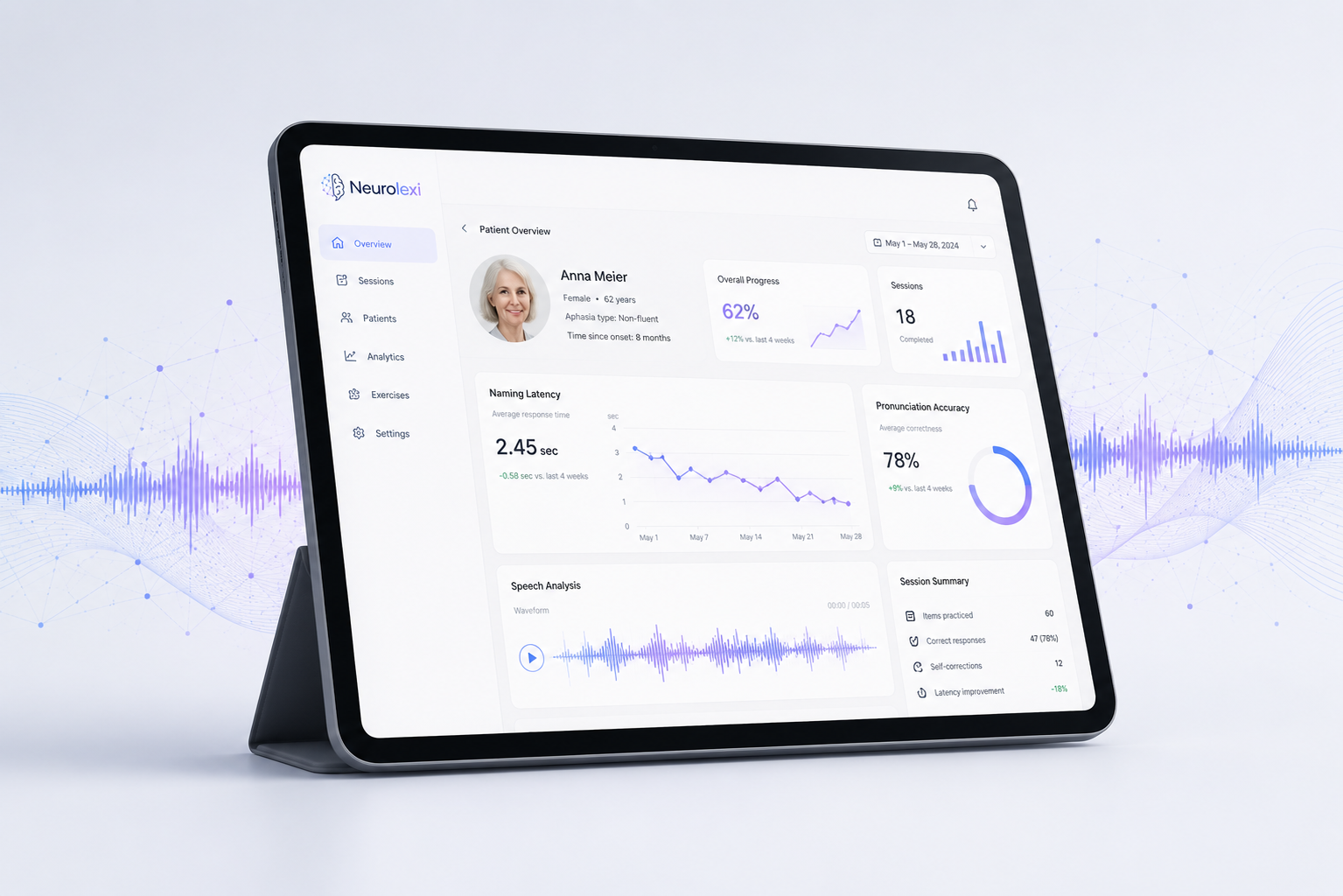
The goal of Neurolexi is to transform scientific findings into accessible digital rehabilitation solutions.
Contact for more info.